
Leeds scientists contribute to review of British woodland creation methods, understanding, and knowledge gaps.

Research from Restoring Hardknott Forest and Wild Ingleborough has contributed to a new paper summarising the current knowledge of creating woodland through natural processes in Great Britain. The synthesis was part of the TreE_PlaNat project and combined the expertise of 31 practitioners and researchers to compile 15 case studies where woodland has been created through natural processes, rather than planting. The paper highlights the benefits of this natural colonisation process, possible limiting factors, identifies knowledge gaps and gives recommendations for policy, research and land management.
Natural colonisation has the potential to create structurally diverse, locally adapted and resilient woodlands, with lower effort in comparison to tree planting. There is, however, still uncertainty as to where and when using natural colonisation is appropriate and most effective. In this new study, researchers and practitioners ranked possible limiting factors, with herbivory by sheep and deer, and seed source proximity, considered to be the most important.

The study has already started to influence policy with Natural England now including hybrid woodland creation approaches in their advice. The National Forestry Company, a partner in the project, is also developing a new suite of forest creation grants based on the findings, aiming to give land managers more flexibility to use hybrid creation approaches. This flexibility in funding is crucial due to the less predictable nature of natural colonisation and traditional woodland creation grants requiring that a particular tree density is achieved within a set timeframe. Land managers must also embrace the uncertainty of natural colonisation and be willing to employ adaptive management to create diverse woodlands and use hybrid approaches when needed.
Cat Scott, a coauthor of the study, based at the University of Leeds, said "This new study does a great job of synthesising perspectives from across the researcher - practitioner spectrum to identify the critical knowledge gaps around natural colonisation. It also highlights that natural colonisation outcomes can vary substantially across locations, so what works at one site may not work at another and flexibility from the funders of woodland creation projects will be essential."
Two of the case studies, informing the conclusions of the study, were based on research from the University of Leeds. Firstly, research from Hardknott Forest shows that, under the right conditions, natural colonisation can be an extremely successful strategy for increasing woodland cover. Clearance of previous plantations at the site left bare soil allowing the perfect opportunity for seedling establishment. Clear-felled areas had a very high average sapling density, with 80% of the trees being Birch. Distance to seed source was also a key factor in determining sapling density, for species not dispersed by animals such as Oak and Rowan.
More information on restoration at Hardknott can be found here:
- Research Paper - Regeneration of native broadleaved species on clearfelled conifer plantations in upland Britain
Research from Wild Ingleborough shows a more cautious picture for the use of natural colonisation for creating new woodlands. Very low remaining woodland cover in the area means natural colonisation has been very slow and tree planting will be required to restore woodland, with a diverse range of species, over a decadal time scale. The research does however highlight three key factors affecting natural colonisation rate: grazing management, distance to existing seed sources and soil type. Sheep grazing was shown to prevent colonisation of trees with a 16% increase per year in sapling density when management was changed to cattle grazing or livestock exclusion.
George Porton, a researcher at the University of Leeds, said - “Our results at Ingleborough are a good example of where a hybrid approach is needed to restore woodland. Many areas are simply too far from existing seed sources, and we lack wind dispersed species like birch which can colonise long distances and are often one of the most successful colonisers at other sites. Tree planting at Ingleborough follows the applied nucleation strategy, helping create the seed source for the future”
More information can be found here:
- Research Paper - Natural colonisation rates in a UK upland landscape under different conservation management approaches following sheep removal
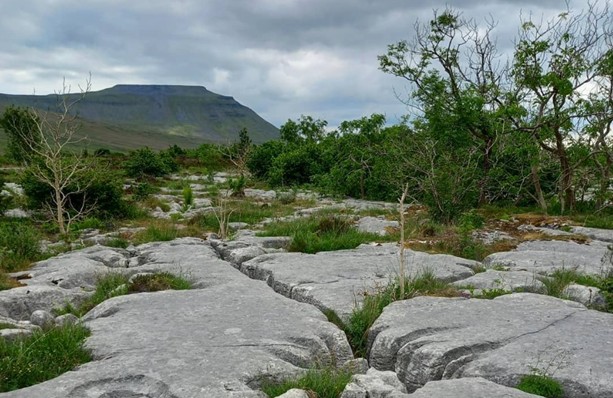
The Ingleborough landscape