
English cities have consistently low levels of access to trees and greenspaces
A new study from the University of Leeds highlights consistently low levels of access to trees and greenspaces across English cities.
Researchers analysed the 3-30-300 rule, a three part framework for measuring tree and greenspace access, in urban neighbourhoods of Leeds, Bradford, Wakefield, York, Manchester, Stoke-on-Trent and Plymouth, and found that at most, only 2% of buildings in any city region met all three components of the rule.
This research, published in Urban Forestry & Urban Greening, was a collaboration between the University of Leeds, University of Edinburgh, Forest Research, the National Library of Scotland and the White Rose Forest.
Trees and greenspaces provide benefits such as improved mental and physical health, reduced urban temperatures, and habitat provision for wildlife. However, existing measures of ‘greenness’ like canopy cover fail to capture how equally trees and greenspaces, and therefore their benefits, are distributed. The 3-30-300 rule recommends that every house, school, and workplace has a view of 3 trees, that there is 30 % canopy cover in each neighbourhood and that each building has a public greenspace within 300 m. By applying this rule to English cities, this study creates a baseline from which priority areas can be identified and progress can be monitored.
Elle Smith, PhD researcher and lead author of the study, said “Many cities and urban areas are setting targets to increase green infrastructure and in particular to plant more trees. This is often with the goal of mitigating the impacts of climate change. By aligning new tree and greenspace targets with the baseline identified in this study, we can make sure we improve access to the full range of benefits, from climate mitigation to improved health and wellbeing.”
The proportion of buildings across all city regions which met each component of the 3-30-300 rule have been summarised and presented in a Venn diagram. This shows that only 1.2% of all buildings met all three rules and highlights that the 30% canopy rule is the main obstacle to success in the English cities. 25.1 % of buildings are not represented in this diagram as they did not meet any of the rules.

A Venn diagram showing the proportion of buildings in all cities studied meeting each component of the 3–30–300 rule as well as different combinations of the components.
Giving each building a score from 0 to 9 for 3-30-300 performance, where 9 means the building meets all three rules, the researchers produced figures for each city showing areas performing well and those needing improvement, often found to be inner-city areas.
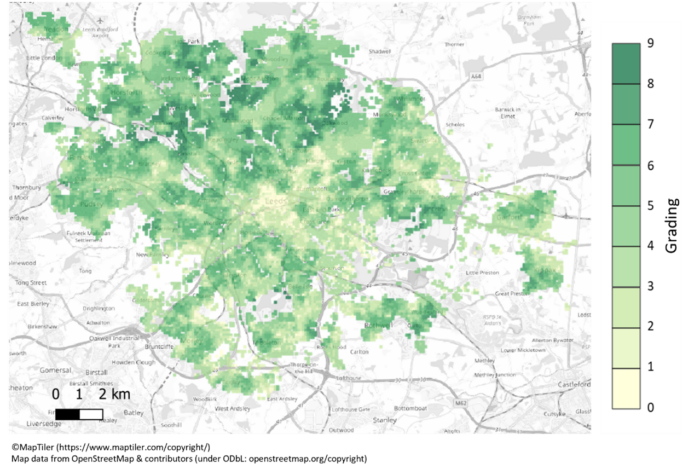
3-30-300 gradings across the study area of Leeds. Each grid cell is 1 ha, and the grading is the average across buildings within each cell. Where there were no buildings within a 1 ha grid cell, the cell is transparent.
The study also compared performance in English cities to 3-30-300 results from studies of other cities around the globe, finding that the English cities in this study perform similarly at the 3-tree component, but worse at the 30 % and 300 m components. These results emphasise the poor performance of these English cities, not only in meeting the 3-30-300 thresholds, but in comparison to other cities where average performance is consistently better.

The results for each component of the 3–30–300 rule (A-C), performance in all three components (D), and average grading for buildings (E) in each city. The detailed method and a 50 m cut off distance for the 3-tree rule were used. Panels A-D also show the mean (black line) and range (grey shading) of results from 3-30- 300 studies in global cities. See Smith et al. (2025) for details of the studies and list of global cities.
Further analysis of the land use of the existing trees in neighbourhoods within these cities revealed which land use types are most important for success at the 3-tree and 30% components. The density of trees in private gardens was found to be most important for the 3-tree rule while the woodland cover in a neighbourhood was found to be most important for the 30% rule. This suggests that planting more trees in private gardens and preventing their removal as well as creating more woodland could improve 3-30-300 success in English neighbourhoods.
Dr Hannah Walker, Urban Forest Research Scientist at Forest Research and co-author on the study, said:
“We know how important urban trees and greenspaces are to people living in towns and cities, and the range of benefits they provide. It’s vital that everyone can experience those benefits. This work builds on the well-established metric of urban tree canopy cover and gives us more detailed insights into how the spatial distribution of trees and greenspaces has an effect on the provision of benefits, at city-wide and neighbourhood scales.
“It shows that increasing canopy cover across urban areas is still very important, and that there are priority areas in each city where local authorities can look to establish new trees where they are most needed. The roles of trees in private gardens in helping neighbourhoods score highly in the 3-30-300 rule is particularly interesting. This work gives us strong evidence for their importance in providing public benefits and should encourage us all to retain and maintain these existing trees.”
The research was supported by the Natural Environment Research Council (NERC), including a SENSE CDT studentship. Full details of the research are available as Open Access via Urban Forestry and Urban Greening