European Young Urban Forester of the Year awarded to Elle Smith
Elle Smith, a postgraduate researcher in the School of Earth, Environment and Sustainability has been announced as the European Young Urban Forester of the Year for 2026.
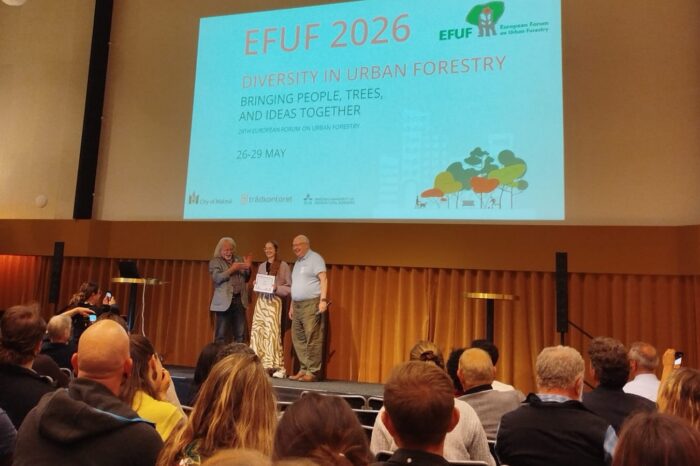
The award celebrates forestry researchers and practitioners who work with trees, woodlands, forests, natural greenspaces and green infrastructure in urban or peri-urban settings. Elle was nominated for this year’s award as a result of her excellent research and her continued, effective collaboration with multiple external partners throughout her PhD.
The award was presented to Elle at the European Forum on Urban Forestry (EFUF) meeting in Malmö, Sweden, where she was attending as a delegate to communicate her research with other members of the forum.
"It was a real honour to be presented with this award at EFUF," Elle said. "During my PhD, I have developed a genuine passion for urban forestry and have thoroughly enjoyed all of the research and collaborations I have been involved in.
“I am excited to continue my career in this field, where I hope to further contribute to improved access to urban trees and greenspaces."
During her PhD, Elle first collaborated with the National Library of Scotland (NLS) and Forest Research (FR) to develop a method to extract tree symbols from historical town plan maps of Edinburgh and Leeds, which were originally created by Ordnance Survey during the 1800s. These very detailed maps had recently been digitised by NLS and the collaboration with Elle represented a ground-breaking opportunity to apply machine learning techniques and generate new information from this valuable asset. As part of the collaboration, a web viewer for Elle’s results was developed for the NLS website, and the research findings were published in Computers, Environment and Urban Systems at a level of detail that has not previously been possible.

For the second research paper of Elle’s PhD, she collaborated with NLS, FR and the White Rose Forest (WRF) to examine access to trees and greenspaces in seven English cities. Elle’s work used the 3-30-300 metric which quantifies the extent to which occupants of each building can see 3 trees from their windows, experience 30% canopy cover in their neighbourhood, and access a public greenspace within 300 metres. She found that access to trees and greenspaces was consistently lower in English cities than in other nations.

Elle wrote a blog with colleagues at WRF to explain how the findings of her work related specifically to Leeds, York, Wakefield and Bradford. As part of the ongoing collaboration, Elle delivered a joint White Rose Forest x Green Streets® webinar for practitioners and policy makers in the region on 22nd April 2026.
Mike Batley, Green Streets® Development Manager, said, “The White Rose Forest’s Green Streets® team has thoroughly enjoyed engaging with Elle through our joint blog post and the webinar, and most of all, through her enthusiasm for urban forestry and learning about the subject. This has been a really complementary experience where we’ve also gained a great deal of insight into the challenge of increasing canopy cover in White Rose Forest cities."