
It’s not just about carbon – why planting the right trees matters for air quality in the UK
Planting trees on a large scale in the UK, as part of pathways to achieving net-zero greenhouse gas emissions, could bring substantial changes to biological emissions from our woodlands, but the scale of change and the compounds emitted varies with tree species planted.
 New woodlands play a key role in proposed pathways to achieving net-zero greenhouse gas emissions in the UK, due to their removal of carbon dioxide from the atmosphere. In the UK, the Climate Change Committee recommended planting between 30 000 and 50 000 hectares of woodland each year until 2050 to achieve net-zero, increasing woodland cover from an average of 13% to 17%-19%.
Afforestation (creating new wooded areas) can deliver many environmental benefits, such as reducing flood risk, taking up carbon, reducing local temperatures, and potentially improving air quality through deposition and dispersion of pollutants. However, trees also exchange carbon in the form of biogenic volatile organic compounds (BVOCs), which are gases released from their leaves. These emissions give forests some of their characteristic smell but they also influence the formation of key air pollutants in the UK, such as ozone and particulate matter. As these pollutants are controlled in the UK under air quality targets, it is important to understand how the emission of BVOCs might change if many more trees are planted.
Research published this week led by Hazel Mooney, a PhD researcher in the Biosphere Atmosphere Group at the University of Leeds, uses computer modelling to investigate the interactions between large scale afforestation and biogenic emissions in the UK.
Hazel Mooney, the lead author of the study, said “There are many complex interactions between the land surface, climate change and the atmosphere. It is important to consider these interactions carefully to improve our understanding of the co-benefits and side-effects associated with climate change mitigation pathways.”
Five potential pathways to increasing woodland cover from 13 to 19% were considered. The authors found that afforestation increased BVOC emissions by up to 123% in 2050. However, the study also found the potential for BVOC emissions to reduce following afforestation, by as much as 3%. The contrast in potential outcomes occurs because different types of trees emit differing levels of specific BVOCs, such as isoprene. For example, oak (a broadleaf tree species) and Sitka spruce (a needleleaf tree species) both strongly emit isoprene. Conversely, silver birch (broadleaf) and Scots pine (needleleaf) emit relatively low amounts of isoprene. The exact change in BVOCs by 2050 associated with afforestation will therefore depend upon the tree species planted and the land cover type replaced by the new woodland. The graph below shows the percentage change in BVOC emissions from the UK following afforestation with varying contributions of trees that are high and low BVOC emitters.
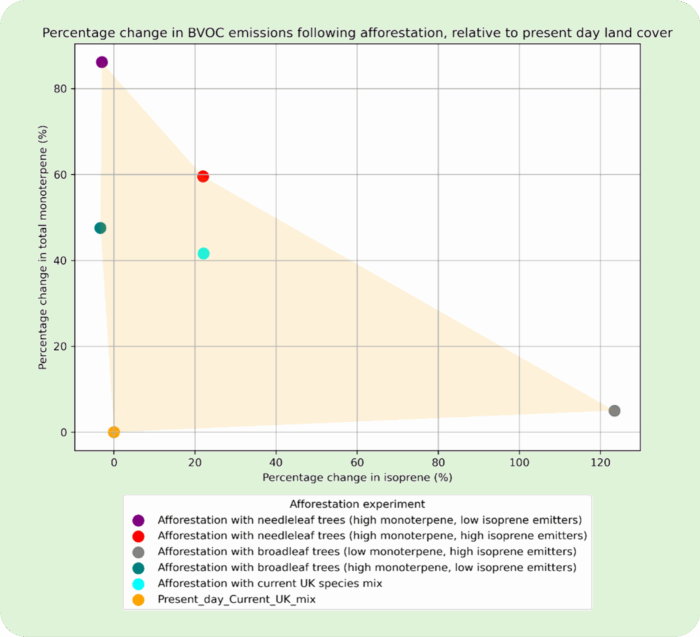
Previously, concerns have been expressed around the risk to air quality associated with increased BVOC emissions following afforestation (e.g. The Royal Society, 2021). This new study focuses on tree species that make up the majority of existing UK woodland or are expected to play a key role in UK forests in the future and examines afforestation in a warmer climate with higher levels of carbon dioxide in the atmosphere. The findings demonstrate that the impact of net-zero aligned afforestation on BVOC emissions can be minimised through careful selection of tree species, which could help to avoid unintended consequences of afforestation on air quality.
“Our study demonstrates that a big increase in woodland area doesn’t necessarily lead to big increases in BVOC emissions – by avoiding exclusive planting of the very highest emitters, we can ensure that new woodlands deliver benefits for climate and nature, whilst minimising any impacts on air quality” said study co-author Dr Cat Scott, Associate Professor of Biosphere-Climate Interactions.
The team of researchers are now undertaking further computer simulations to investigate the impact on air pollutants associated with the biogenic emissions reported in this study.
The research was supported by the Natural Environment Research Council (NERC), including a PANORAMA DTP studentship, and with CASE award funding from the United Bank of Carbon. The full article is available as Open Access via Biogeosciences.